Originally published on Medium. Text and ideas by Piero Pasquariello.
The article
Supply. Burns. Staking rewards. Maybe the hard cap.
Those are important, of course.
But one section on the Cronos website caught my attention for a different reason: “How the Cronos App Generates Revenue.”
It is not the loudest part of the page, but it may be one of the most useful ones.
Because it does not only ask:
“Where can revenue come from?”
It also starts answering a second question:
“Where can that revenue go?”
That is the part users should not skip.
Why this section stands out
A lot of crypto discussions stop at very surface-level points.
People talk about token supply, rewards, or product features, but they often miss the connection between product activity and what happens around the ecosystem.
This section tries to make that connection easier to see.
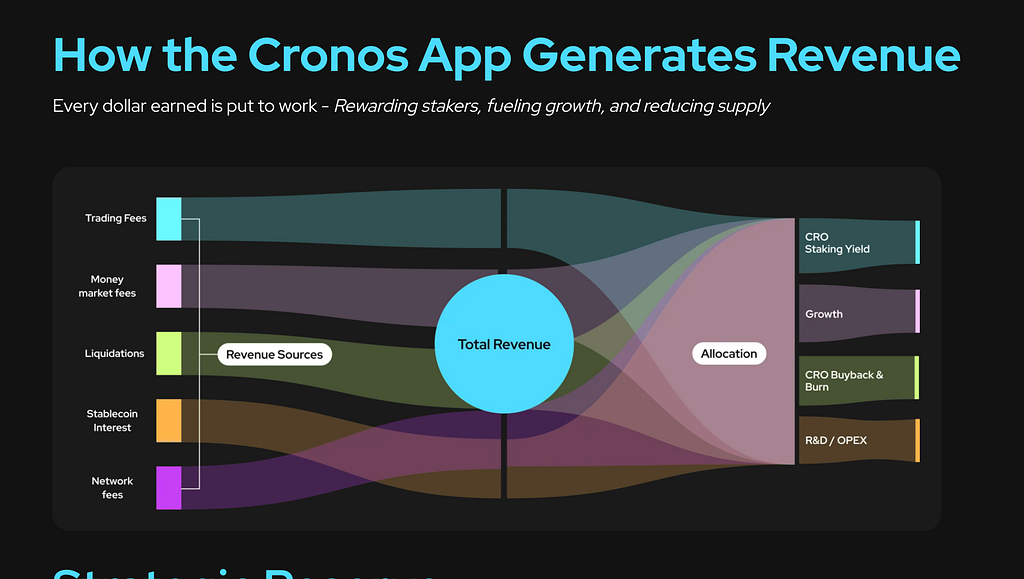
On the left side of the visual, the page shows possible revenue sources, including:
That already matters because it shows revenue as something that can come from different parts of app and network activity, not just one single stream.
For a new user, this makes the page easier to understand.
For someone already following Cronos, it gives a cleaner way to explain how the app could connect back to CRO.
The allocation side matters even more
The part I would pay even more attention to is the right side of the diagram.
That is where the page shows how revenue may be allocated.
The categories shown include:
This is where the section becomes more interesting.
It is not simply saying “the app generates revenue.”
It is showing that revenue has a possible role inside a bigger system.
Some can support staking yield. Some can support growth. Some can go toward buybacks and burns. Some can help fund development and operations.
That kind of explanation is useful because it gives users a better framework.
Instead of looking at CRO only through one metric, the page helps connect different pieces together.
Why users should care
The reason this matters is simple.
If an app wants to become more than a nice interface, people eventually need to understand how activity inside the product can support the broader ecosystem.
This section gives a starting point for that.
It helps users think beyond:
“What is the supply?”
“What is the feature?”
And moves the conversation toward:
“How does activity flow through the system?”
That is a much better question if you want to understand the long-term direction.
What this says about Cronos
To me, this section says that Cronos is trying to make the CRO story easier to follow.
Not by hiding the mechanics behind vague wording, but by showing the basic flow visually:
revenue sources → total revenue → allocation.
And that simplicity matters.
Most users do not want to read ten governance threads just to understand the basic idea. They need a clean entry point first.
This section gives them one.
It does not answer every possible question, and it does not need to.
Its job is to make the revenue logic easier to see.
The most interesting part of this section is not the diagram itself.
It is the idea behind it.
Cronos App is not presented only as a product users may open on their phone.
On the About $CRO page, it is also shown as a possible revenue engine connected to staking, growth, buybacks, burns and development.
That is the part worth paying attention to.
Because if you want to understand where Cronos is trying to go, following the revenue flow may be more useful than only looking at isolated numbers.
Official website: https://cronos.com About $CRO page: https://cronos.com/about-cro Cronos App waitlist: https://cronos.com/?r=0actd Official X: https://x.com/CronosApp
Content for informational purposes only. It is not financial, legal, or tax advice, nor an offer, invitation, or solicitation to invest. Always refer to official sources.