Originally published on Medium. Text and ideas by Piero Pasquariello.
The article
One thing I’ve noticed is that most beginners spend a lot of time deciding what to buy, but very little time understanding how orders actually work.
People often ask questions like:
Should I buy crypto or stocks?
Which asset has more potential?
What is the best market right now?
Those are understandable questions, but there is another topic that often gets overlooked even though it can have a direct impact on the experience.
How are orders actually placed?
Understanding the difference between a market order and a limit order may not sound exciting at first, but it is one of the most practical concepts someone can learn before focusing on specific assets or trying to predict market movements.
Every trade starts with an order
Whether someone is looking at crypto, stocks or another market, every transaction usually starts with an order.
An order is simply an instruction that tells the market what you want to do.
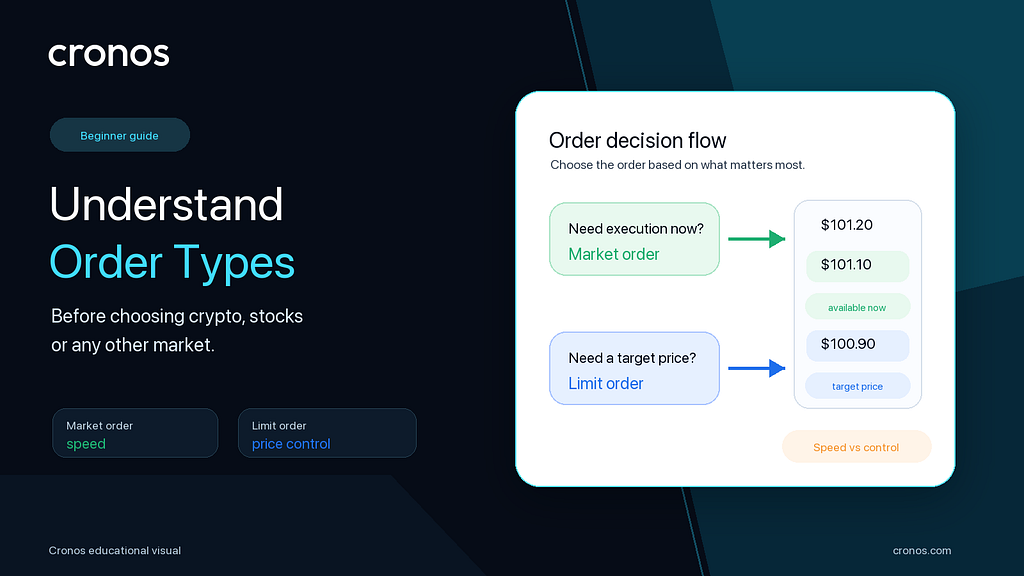
At a basic level, most beginners will come across two common order types:
Both can be used to buy or sell an asset, but they work in different ways and serve different purposes.
Understanding that difference can help users make more informed decisions when interacting with markets.
What is a Market Order?
A market order prioritizes speed.
When someone places a market order, they are essentially saying:
“Execute my order as soon as possible at the best available price.”
The biggest advantage is simplicity.
In most situations, the order is executed quickly because the goal is immediate execution rather than waiting for a specific price level.
For many beginners, market orders feel intuitive because they are simple and immediate.
The trade-off is that speed sometimes comes at the cost of precision.
Because markets move constantly, the final execution price may be slightly different from the price visible when the order was submitted.
Useful when immediate execution is important
Prices can move quickly
Final execution price may differ slightly from expectations
Less control over the exact purchase or sale price
What is a Limit Order?
A limit order prioritizes price control.
Instead of accepting the current market price, the user selects a specific price level.
The instruction becomes:
“Only execute this order if the market reaches my chosen price.”
This gives the user more control over the transaction.
Some users prefer limit orders because they like knowing exactly which price they are targeting.
The trade-off is that patience becomes part of the process.
If the market never reaches the selected price, the order may remain unfilled.
Greater control over price
Useful for targeting a specific entry or exit level
Helps users define their preferred execution price
Execution is not guaranteed
The market may move away before the order is filled
It may take longer for the order to execute
Neither order type is automatically better.
The best choice often depends on what someone is trying to achieve.
Sometimes speed matters more.
Sometimes price control matters more.
Understanding the difference helps users decide which approach better fits their situation.
Why this matters for beginners
One reason I think order types deserve more attention is that many newcomers focus almost entirely on the asset itself.
They spend hours comparing markets, reading news and trying to decide what to buy.
But they often spend very little time learning how orders actually work.
In reality, understanding the tools used to interact with markets can be just as important as understanding the assets themselves.
This is not about becoming a professional trader.
It is about becoming a more informed participant.
The concepts behind market orders and limit orders are useful whether someone is exploring crypto, stocks or other market categories.
Financial education is often associated with charts, indicators and complex strategies.
In reality, some of the most valuable lessons are much simpler.
Market orders and limit orders may look like a small detail, but they are often one of the first concepts that can help beginners feel more confident when interacting with markets.
Before choosing between crypto, stocks or any other asset, it may be worth understanding how orders work first.
Sometimes the most useful lessons are also the simplest ones.